
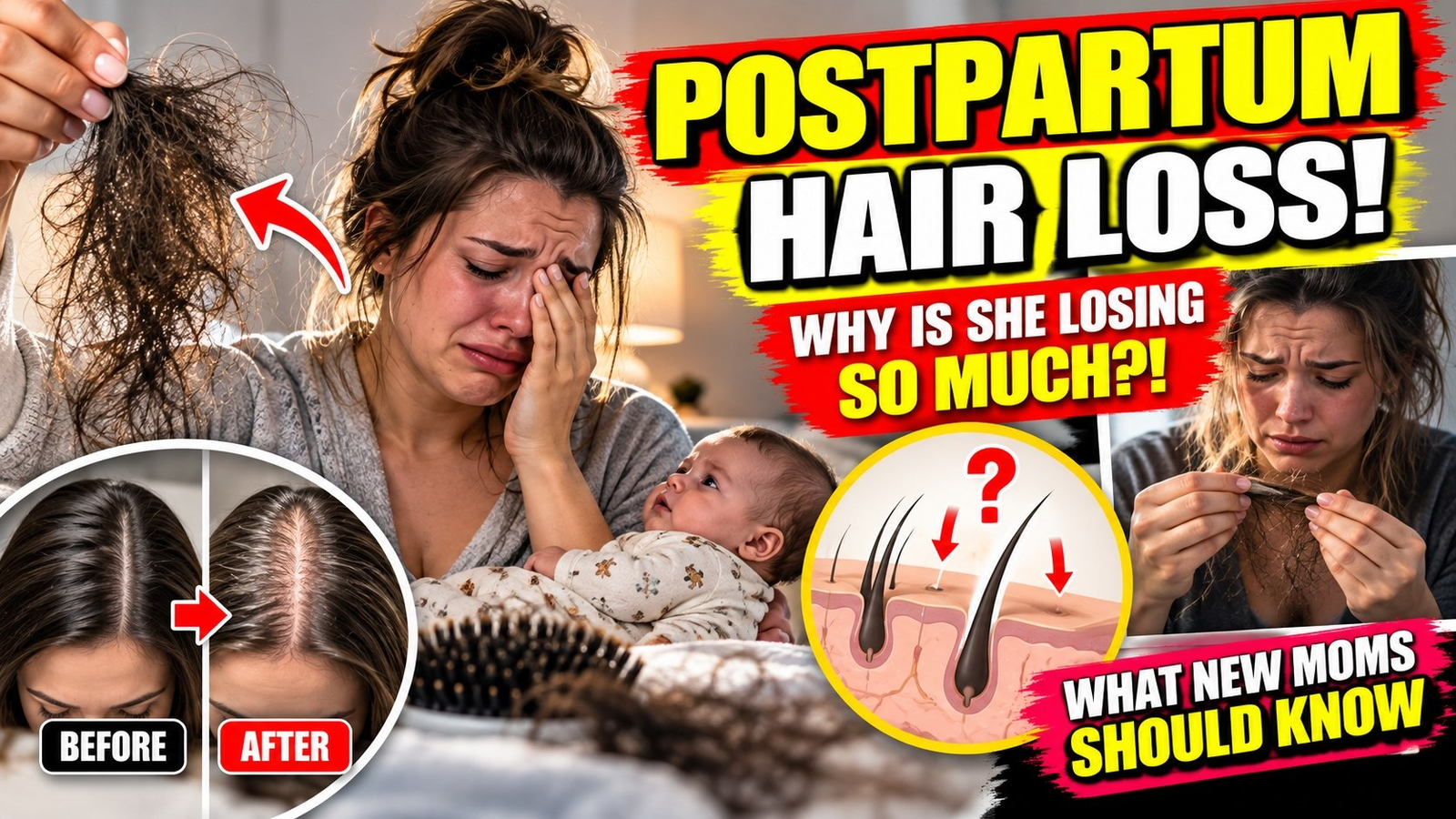

A short video showing a new mother caring for her baby while appearing overwhelmed by heavy hair shedding is touching a nerve with parents online.
The video describes her as a postpartum mother struggling with sleepless nights while losing what appears to be a large amount of hair.
For many new mothers, the experience can be frightening.
But there is an important medical explanation that may help put the situation into perspective.
Postpartum hair shedding is common, and in many cases it is temporary.
WHAT DOES THE VIRAL VIDEO SHOW?
The video appears to show a mother sitting with her young baby while dealing with significant hair shedding.
Text over the footage describes the situation as:
“Postpartum mom breaks down while caring for her baby, losing massive amounts of hair from sleepless nights.”
The clip has been presented as a heartbreaking look at the physical and emotional challenges that can come with caring for a newborn.
However, the video does not provide enough information to determine the woman’s medical history, how long she had been postpartum, or whether another medical condition contributed to her hair loss.
WHY DOES HAIR FALL OUT AFTER HAVING A BABY?
Postpartum hair shedding is a well-recognized phenomenon.
According to the American Academy of Dermatology, many new mothers experience noticeably increased hair shedding a few months after giving birth.
The medical term commonly used for this excessive shedding is telogen effluvium.
Hormonal changes are a major reason.
During pregnancy, increased estrogen levels keep more hairs in the growth phase for longer. This can make hair appear thicker and fuller.
After childbirth, hormone levels change again.
As the body returns toward its normal hormonal state, many hairs that had remained in the growth phase enter the resting phase.
Several months later, those hairs can shed.
That can make the amount of hair coming out seem surprisingly large.
IS LOSING THIS MUCH HAIR NORMAL?
It can be.
The American Academy of Dermatology says excessive shedding after childbirth is common and usually temporary.
Many women notice the shedding a few months after delivery, and it can become particularly noticeable around several months postpartum.
Cleveland Clinic also explains that postpartum hair loss commonly occurs around three months after childbirth and may continue for several months.
For many women, the hair gradually returns toward its previous fullness.
WHEN DOES POSTPARTUM HAIR LOSS START?
The timing can vary.
Some women begin noticing increased shedding around two or three months after giving birth, while others notice it later.
The American Academy of Dermatology says excessive shedding can begin a few months after childbirth and often peaks around four months.
This means a mother may feel perfectly fine about her hair immediately after giving birth and then suddenly notice much more hair in the shower, on her pillow or in her hairbrush several months later.
WHY DOES IT LOOK SO DRAMATIC?
One reason postpartum shedding can be so alarming is that many hairs can enter the shedding phase around the same general period.
During pregnancy, fewer hairs may be shed because of hormonal changes.
After delivery, those retained hairs eventually shed.
As a result, a new mother can suddenly see large amounts of hair coming out at once.
Cleveland Clinic notes that some women may even notice handfuls of hair during washing.
That can understandably be upsetting.
THE EMOTIONAL SIDE OF POSTPARTUM HAIR LOSS
The physical change is only part of the story.
A new mother may already be dealing with:
• Interrupted sleep
• Feeding and caring for a newborn
• Major hormonal changes
• Recovery after childbirth
• Changes in her body
• Less time for herself
• Emotional stress
Then she may suddenly notice significant changes to her hair.
For someone who has always viewed her hair as part of her appearance or identity, seeing large amounts of it fall out can be emotionally difficult.
That does not necessarily mean something is medically wrong.
But it does mean the experience can feel overwhelming.
DOES SLEEP DEPRIVATION CAUSE POSTPARTUM HAIR LOSS?
The viral caption connects the mother’s hair loss with sleepless nights.
Sleep deprivation and stress can certainly affect how someone feels physically and emotionally.
However, it would be inaccurate to say that the video proves sleeplessness is the direct cause of this woman’s hair shedding.
Hormonal changes after pregnancy are a major recognized explanation for postpartum shedding.
Other factors can also contribute to hair loss, which is why persistent or unusual shedding may need medical evaluation.
WILL THE HAIR GROW BACK?
In most cases of typical postpartum shedding, yes.
The American Academy of Dermatology says most women regain their normal hair fullness by their child’s first birthday.
Cleveland Clinic similarly explains that postpartum hair loss is generally temporary and that hair usually returns toward its previous fullness.
The process isn’t necessarily immediate.
A mother may continue noticing shedding before new growth becomes obvious.
Small new hairs can also appear around the hairline and other areas as the growth cycle normalizes.
WHAT CAN A NEW MOTHER DO?
There is no guaranteed way to completely prevent normal postpartum shedding because the underlying hormonal changes are part of the process.
But dermatologists recommend gentle hair care while the hair recovers.
That can include:
• Being gentle when washing and brushing
• Avoiding hairstyles that pull tightly on the hair
• Limiting excessive heat and damaging treatments
• Using products appropriate for the hair type
• Eating a balanced diet
• Discussing supplements with a healthcare professional rather than taking them automatically
A shorter hairstyle may also make thinning hair look fuller and can be easier to manage during the newborn stage.
WHEN SHOULD SOMEONE TALK TO A DOCTOR?
Although postpartum shedding is common, not every case of hair loss is simply postpartum hair shedding.
The American Academy of Dermatology recommends seeing a dermatologist if hair does not regain its normal fullness by around one year after childbirth.
Other conditions can also cause hair loss.
Cleveland Clinic notes that issues such as thyroid disease or iron deficiency can contribute to hair loss.
A healthcare professional can determine whether additional testing is appropriate.
ONE MORE THING NEW PARENTS SHOULD KNOW
Loose hair around a newborn can create another, much rarer concern.
A strand of shed hair can sometimes wrap tightly around a baby’s finger, toe or another body part.
This is known as a hair tourniquet.
The American Academy of Dermatology and Cleveland Clinic both advise parents to check for loose hairs around babies, particularly during periods of heavy postpartum shedding.
If a hair is tightly wrapped and cannot be safely removed, medical attention may be necessary.
THE BIGGER MESSAGE BEHIND THE VIDEO
The viral video is emotional because it captures something many new mothers experience but don’t always talk about.
Postpartum recovery isn’t only about the first few days after childbirth.
Physical changes can continue for months.
Hair shedding can arrive at a time when a mother is already exhausted and adjusting to an entirely new routine.
For many women, however, the shedding is temporary.
The hair-growth cycle eventually moves forward, and normal fullness generally returns.
THE BOTTOM LINE
The mother in the viral video appears to be struggling with significant hair shedding while caring for her baby.
We cannot determine her exact medical condition or personal circumstances from the short clip alone.
But the experience shown is consistent with a well-known postpartum phenomenon.
After childbirth, hormonal changes can cause many hairs to enter the shedding phase, sometimes resulting in surprisingly large amounts of hair coming out several months after delivery.
For most women, this is temporary and hair gradually returns toward its previous fullness.
So if a new mother suddenly finds hair everywhere — in the shower, on her pillow, in her brush or on her clothes — it can be frightening.
But postpartum hair shedding is often a normal part of the body’s transition after pregnancy.
IMPORTANT NOTE:
This article explains general medical information about postpartum hair shedding and does not diagnose the woman shown in the viral video. Anyone experiencing persistent, severe, unusual or concerning hair loss should speak with a qualified healthcare professional.
