
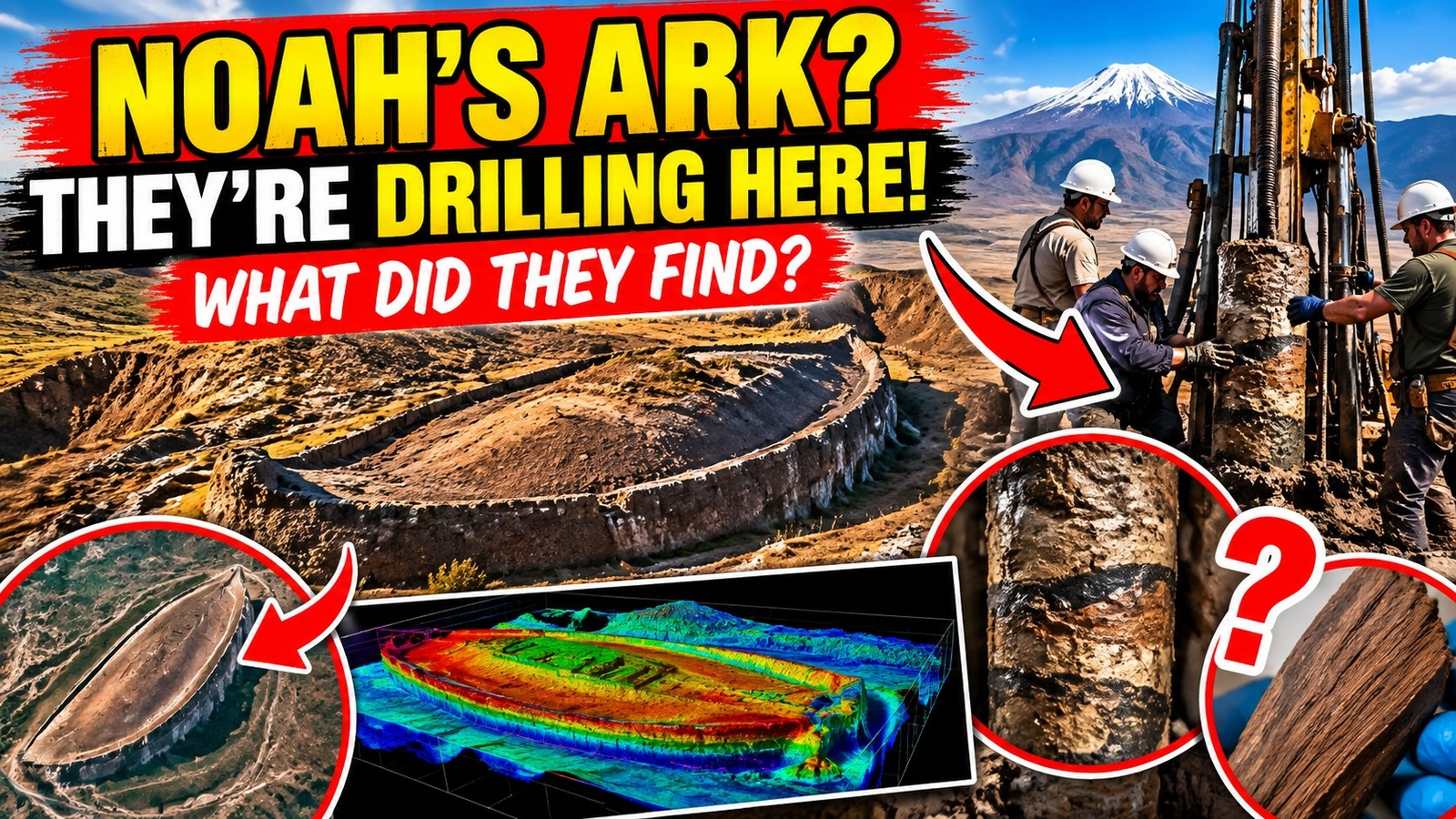

For decades, a strange boat-shaped formation in eastern Türkiye has been at the center of one of the world’s most famous archaeological mysteries.
Now, researchers are going deeper than ever before.
A major scientific investigation is underway at the Durupınar formation near Mount Ararat, where some researchers believe the unusual landform could be connected to the biblical story of Noah’s Ark.
The latest investigation involves advanced radar scanning, geological surveys and core drilling.
And researchers have reported unusual features beneath the surface.
But there is an important question:
Have they actually found Noah’s Ark?
Not yet.
WHAT IS THE DURUPINAR FORMATION?
The Durupınar formation is a large, boat-shaped geological feature in eastern Türkiye.
It was identified in aerial photographs in 1959 by Turkish Army Captain İlhan Durupınar.
The formation measures approximately 157 meters, or about 515 feet, in length.
That measurement has attracted attention because Genesis describes Noah’s Ark as being 300 cubits long.
Supporters of the Ark theory argue that the dimensions and unusual shape make the site worthy of investigation.
Critics, however, say the formation can be explained through ordinary geological processes.
And that disagreement has continued for decades.
WHY DO PEOPLE THINK IT COULD BE NOAH’S ARK?
The biggest reason is its unusual shape.
From above, the formation resembles the outline of a large boat.
Supporters of the theory have also pointed to the site’s approximate dimensions and various geological and geophysical observations as reasons to investigate it further.
Modern surveys have detected linear and angular features beneath parts of the formation.
Researchers involved in the current investigation say some of these features resemble possible corridors, rooms or other organized structures.
But there is an important distinction:
A shape that looks artificial does not automatically prove that it was built by humans.
Natural geological formations can also produce surprisingly regular patterns.
THAT IS WHY THE 2026 INVESTIGATION MATTERS
In 2026, Türkiye officially authorized a multidisciplinary research project at the Durupınar formation.
The project is being directed by Professor Cenker Atila of Sivas Cumhuriyet University and conducted in cooperation with Noah’s Ark Scans.
Researchers are using several technologies, including:
• Ground-penetrating radar (GPR)
• Electrical resistivity tomography (ERT)
• LiDAR mapping
• Geological surveys
• Soil analysis
• Core drilling
The goal is to build a much more detailed picture of what lies beneath the unusual formation.
WHAT DID THE RADAR SHOW?
Previous surveys detected unusual subsurface patterns.
According to the current research team, GPR and ERT surveys conducted over several years identified linear structures, right-angle features and possible corridor- or room-like areas beneath the formation.
The team says some of these features occur several meters below the surface.
But radar images are not the same thing as archaeological discoveries.
A radar anomaly can have many possible explanations.
That is why researchers are now collecting physical samples.
THEY HAVE STARTED DRILLING
This is one of the biggest developments in the 2026 investigation.
In September 2026, the research team announced that core drilling had begun at the site.
The team said it was collecting samples from depths of up to approximately 18 meters.
The cores are intended for laboratory testing, including geological, mineralogical, organic and other analyses.
Researchers also say they are investigating cavities and other subsurface features identified during earlier surveys.
According to the project team, some recovered material contains significant organic material.
But that does NOT automatically mean it came from Noah’s Ark.
Organic material can occur naturally in soil and sediment.
Laboratory analysis is therefore critical.
WHAT ABOUT THE CLAIM OF “PETRIFIED WOOD”?
Some viral posts have suggested that researchers have already discovered evidence of ancient wood.
The current research team has reported organic-rich material in some core samples and has suggested that further testing could help determine its origin.
However, there is currently no verified archaeological finding proving that the material is wood from Noah’s Ark.
That distinction is extremely important.
A sample containing organic material is not automatically evidence of a wooden ship.
Scientists need to determine exactly what the material is, how old it is and how it got there.
THERE IS ALSO A STRONG GEOLOGICAL COUNTERARGUMENT
The Durupınar Ark theory is highly disputed.
A 1996 geological analysis by Lorence Collins and David Fasold argued that the formation is a natural geological structure rather than a ship.
Their analysis described the formation in terms of natural rock layers, folding, erosion and other geological processes.
They also argued that several objects previously described as evidence of the Ark had natural geological explanations.
Other geologists have likewise argued that the boat-like shape can be explained without invoking a man-made vessel.
So there are currently two competing interpretations:
One suggests that the formation could preserve evidence of a large ancient structure.
The other explains the shape through geology.
THE 2026 RESEARCH IS DESIGNED TO TEST THAT QUESTION
This is why the current investigation is different from simply taking another photograph of the formation.
Researchers are collecting physical samples and combining them with subsurface imaging.
Core samples can be examined in laboratories.
Geological layers can be compared inside and outside the formation.
And the results can potentially help determine whether the unusual structure is primarily geological or contains evidence of human construction.
WHAT HAVE THEY ACTUALLY FOUND SO FAR?
This is where viral headlines can become misleading.
Researchers have reported:
• Unusual subsurface radar features
• Linear and angular anomalies
• Possible voids or cavity-like areas
• Organic-rich material in some samples
• A large boat-shaped surface formation
• New core samples that are being sent for laboratory analysis
But researchers have NOT publicly established that they have found Noah’s Ark.
The investigation remains ongoing.
WHY THE “NOAH’S ARK FOUND” HEADLINES ARE PREMATURE
A viral video may show an unusual rock formation and describe it as “what they found near Noah’s Ark.”
That wording can make it sound as though archaeologists have already discovered the biblical vessel.
That is not what the current evidence establishes.
The scientific project is investigating whether the formation has a natural geological explanation or whether it contains evidence of something constructed by humans.
The answer has not yet been established.
WHAT HAPPENS NEXT?
The next major step is laboratory analysis of the recovered material.
Researchers need to determine the composition and origin of the samples.
They also plan additional analysis of the geophysical data.
The research team has indicated that further field seasons are expected, with additional work planned beyond 2026.
That means the mystery is not ending with the current drilling.
It is entering a new phase.
THE BOTTOM LINE
A strange boat-shaped formation has attracted attention for more than six decades.
Now, scientists are conducting one of the most extensive investigations ever carried out at the site.
Modern radar, LiDAR, electrical imaging and core drilling are being used to investigate what lies beneath the surface.
Researchers have reported unusual features and organic-rich material, but those findings have not established that Noah’s Ark has been discovered.
At the same time, the geological explanation for the formation remains a serious alternative supported by previous geological research.
So, did scientists finally find Noah’s Ark?
Not yet.
But for the first time in decades, researchers are collecting substantially more physical data that could help determine what the mysterious formation actually is.
And that is why the next laboratory results could be more important than another viral video.
IMPORTANT NOTE:
The Durupınar formation’s connection to Noah’s Ark remains an unproven claim. The current research project is investigating the site’s geological and archaeological characteristics; its own research materials state that the available data are suggestive rather than conclusive. The findings described above should therefore not be presented as proof that the biblical Ark has been found.
