What begins as a normal labor can sometimes change very quickly.
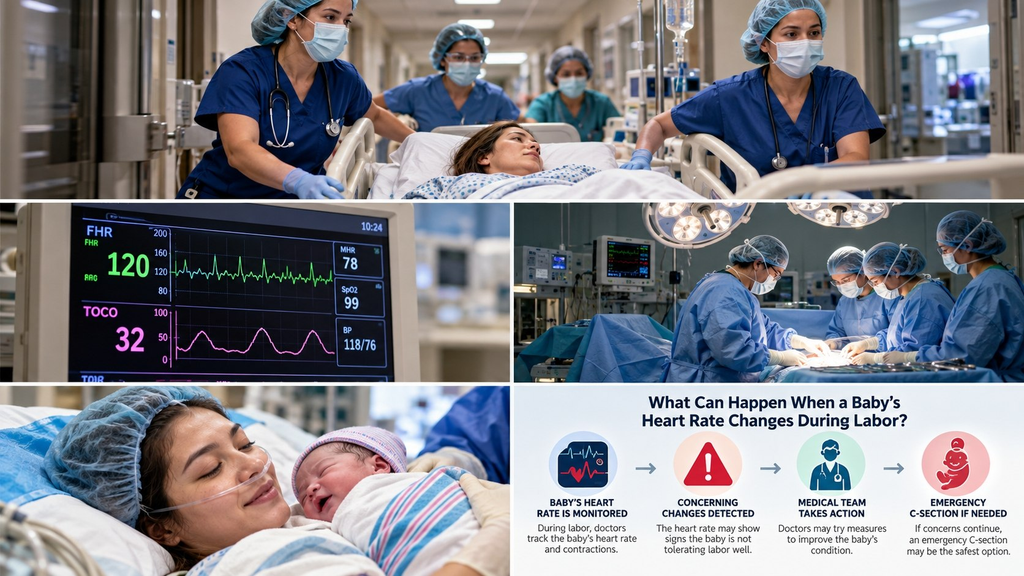
A mother may be pushing and preparing for a vaginal birth when doctors and nurses suddenly become concerned about the baby’s condition. In some situations, the medical team may decide that the baby needs to be delivered by cesarean section as quickly as possible.
A video circulating online captures one of those frightening moments, showing a laboring mother being rushed toward an emergency C-section after concerns arose about the baby’s heartbeat.
But what actually happens when doctors become concerned about a baby’s heart rate during labor?
WHY DOCTORS MONITOR A BABY’S HEART RATE DURING LABOR
During labor, medical teams may monitor the baby’s heart rate to assess how the baby is responding to contractions and the stresses of labor.
Changes in the heart-rate pattern can sometimes indicate that the baby may not be tolerating labor well. However, an abnormal heart-rate pattern does not automatically mean that something is seriously wrong.
Doctors consider the entire clinical situation, including the heart-rate tracing, the mother’s condition, the progress of labor and other factors.
This is why a sudden change on the monitor can lead to rapid action while doctors determine what is happening.
WHAT DOES A CONCERNING HEART-RATE PATTERN MEAN?
There are different types of changes that doctors may see during fetal monitoring.
Some changes can occur temporarily during contractions and may resolve with changes in the mother’s position or other medical measures. Other patterns may be more concerning, particularly if they persist or occur alongside other signs that the baby may be struggling.
For example, a prolonged decrease in fetal heart rate can require immediate medical assessment and preparation for urgent delivery while doctors investigate possible causes.
Importantly, someone watching a short social-media video cannot determine exactly what happened medically from the footage alone.
WHY WOULD DOCTORS PERFORM AN EMERGENCY C-SECTION?
A cesarean section may be recommended when doctors believe continuing with a vaginal delivery could create greater risk for the mother or baby.
One reason can be concern that the baby is not receiving enough oxygen and needs to be delivered quickly.
Other reasons can include labor that is not progressing, heavy bleeding, certain problems with the placenta, or other complications.
In some emergencies, the decision can happen very quickly.
That can be terrifying for a mother who was expecting to continue pushing and deliver vaginally.
DOES AN EMERGENCY C-SECTION ALWAYS MEAN SOMETHING WENT TERRIBLY WRONG?
No.
The word “emergency” can sound frightening, but emergency cesareans can occur for different reasons and with different levels of urgency.
Some situations involve an immediate threat to the mother or baby, while others require an urgent delivery because doctors believe delaying birth could increase risk.
The specific circumstances matter.
That’s also why it is important not to assume that a particular video tells the complete medical story of the mother or baby.
WHAT HAPPENS DURING AN EMERGENCY C-SECTION?
A C-section is an operation in which the baby is delivered through an incision in the abdomen and uterus.
When circumstances allow, spinal or epidural anesthesia is commonly used, meaning the mother remains awake while the lower part of her body is numbed.
In situations where the baby needs to be delivered extremely quickly, general anesthesia may sometimes be necessary.
After delivery, the baby’s condition is assessed.
If the C-section was performed because doctors were concerned about the baby’s wellbeing, the baby may be assessed immediately by a pediatric or neonatal team and may receive medical assistance if necessary.
WHY THE MEDICAL TEAM MAY APPEAR TO MOVE SO QUICKLY
One of the most difficult parts for families is seeing how rapidly the delivery room can change.
A mother can go from pushing and expecting a vaginal delivery to having multiple members of the medical team preparing for an urgent operation.
From the outside, it can look chaotic.
Inside the delivery room, however, the team may be responding to information from fetal monitoring, the mother’s condition and the progress of labor.
When there is concern about the baby’s wellbeing, time can become an important consideration.
WHAT CAN CAUSE PROBLEMS DURING LABOR?
There isn’t one single explanation for every concerning fetal heart-rate pattern.
Possible complications during labor can include problems involving the umbilical cord, placenta, contractions, reduced oxygen delivery, or other maternal or fetal conditions.
Doctors have to evaluate the individual situation rather than relying on one monitor reading alone.
For example, complications involving the placenta can sometimes affect the baby’s wellbeing and may require rapid delivery.
WHY THESE MOMENTS ARE SO EMOTIONAL FOR PARENTS
For many parents, childbirth is already an intense experience.
When a medical team suddenly says that an emergency C-section may be necessary, fear can take over almost immediately.
Parents may not understand everything happening around them. They may simply see doctors moving quickly and hear instructions being given.
That’s why videos showing emergency deliveries often generate strong emotional reactions online.
Viewers may ask:
“What happened to the baby’s heartbeat?”
“Why did they suddenly need a C-section?”
“Was the baby okay?”
“Could this happen during a normal labor?”
Those questions are understandable, but the answers depend on the actual medical circumstances of each birth.
THE IMPORTANT THING TO REMEMBER
A baby’s heart-rate monitor is an important tool during labor, but a short video cannot tell viewers everything doctors knew at the time.
A concerning heart-rate pattern can lead medical professionals to reassess the situation and, when necessary, consider an expedited delivery.
In some circumstances, an emergency C-section may be the safest way to deliver the baby.
At the same time, an abnormal monitor reading does not automatically mean that a baby has died or that a catastrophic outcome is occurring.
Only the medical team caring for the mother and baby can interpret the complete clinical picture.
FINAL THOUGHTS
The viral video is a powerful reminder of how quickly circumstances can change during childbirth.
One moment, a mother may be preparing for a vaginal delivery. The next, doctors may be preparing an operating room because they have become concerned about the baby’s wellbeing.
For families going through labor, those moments can be frightening. But emergency C-sections are performed because doctors may determine that delivering the baby quickly is safer than continuing with labor.
If you’re pregnant or preparing for childbirth, discuss questions about fetal monitoring, emergency C-sections and your individual birth plan with your obstetrician or midwife.
This article is for general informational purposes and does not provide medical advice. The specific circumstances of the woman and baby shown in any social-media video cannot be determined from the video alone.
SOURCES
American College of Obstetricians and Gynecologists (ACOG) — Fetal Heart Rate Monitoring During Labor
NHS — Caesarean Section
NHS — Placenta Complications
NHS — Fetal Monitoring During Labor