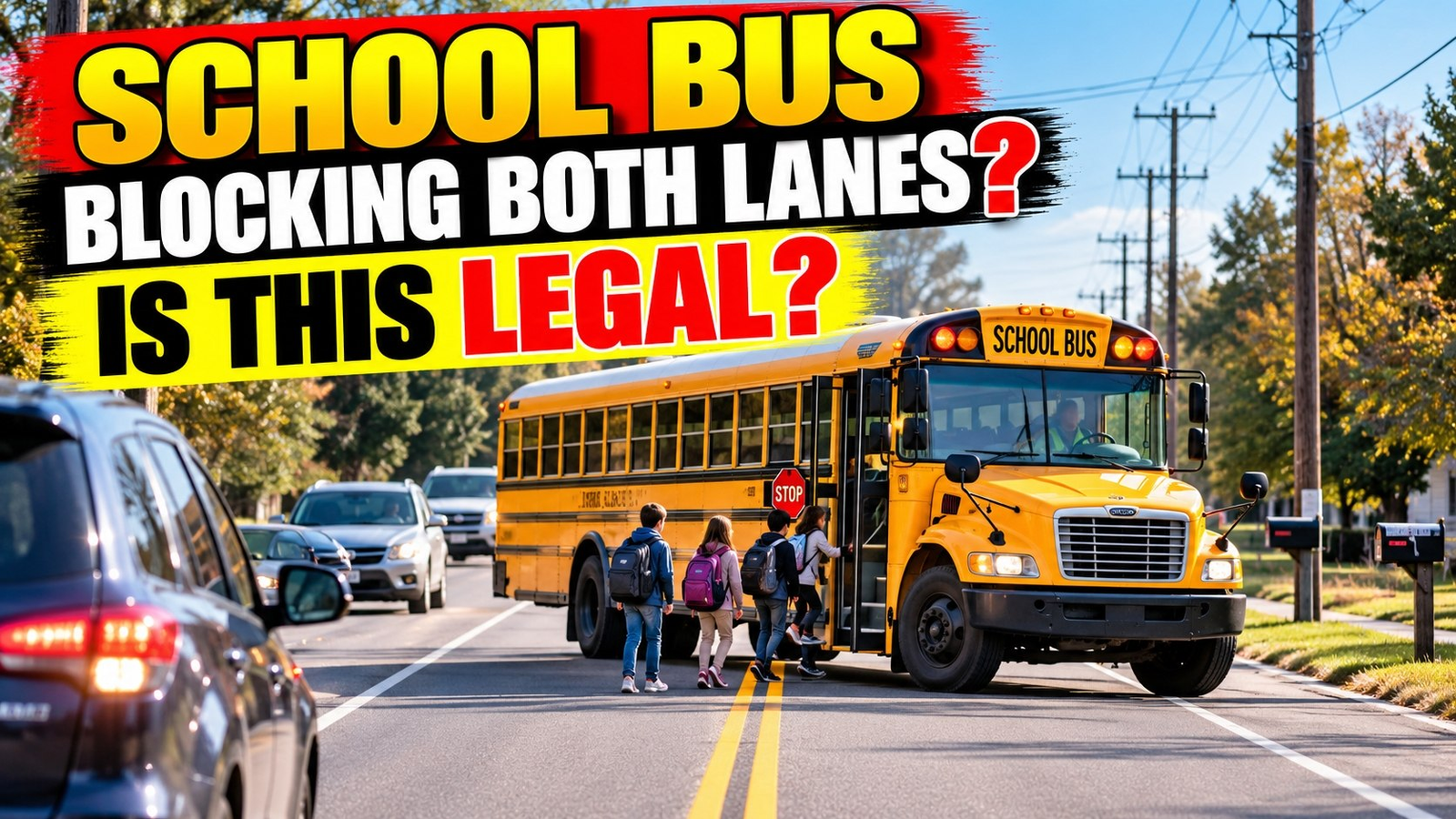

A short video showing a yellow school bus positioned across both lanes of a road has sparked a simple question online:
“Are school buses supposed to block both lanes?”
The footage appears to show a school bus stopped across a two-lane roadway while students are nearby. Because the bus occupies the roadway, vehicles approaching from either direction appear unable to continue normally.
But while the scene may look unusual to some drivers, there can be a safety reason for a school bus to temporarily occupy part or all of a roadway during student pickup or drop-off.
WATCH THE VIDEO
WHY WOULD A SCHOOL BUS BLOCK BOTH LANES?
School buses are designed to protect children while they enter or leave the vehicle.
When a bus stops to pick up or drop off students, it may activate warning lights and extend its stop arm. These signals tell approaching motorists that children may be entering or leaving the bus.
According to the National Highway Traffic Safety Administration, school-bus laws vary from state to state. Generally, flashing yellow lights indicate that a bus is preparing to stop, while flashing red lights and the stop arm indicate that the bus has stopped and students are getting on or off. Motorists are generally required to stop when the bus is displaying those stop signals, subject to the specific rules of the state.
In some circumstances, a bus may also be positioned in a way that prevents vehicles from attempting to pass.
IS IT LEGAL TO BLOCK BOTH LANES?
There is no single nationwide rule that makes the exact maneuver legal everywhere in the United States.
State laws and transportation regulations can be different.
For example, Mississippi law specifically permits a school bus driver to block the two outermost right lanes while receiving or discharging school children. On a two-lane road, that can mean blocking both lanes. The law limits the practice to the period when students are actually being received or discharged.
Other states use different rules.
Colorado regulations, for example, generally require a school transportation vehicle to stop as far to the right as possible, but provide an exception allowing the vehicle to block a lane when students being picked up or dropped off are required to cross the roadway.
This means that seeing a school bus occupying more than one lane does not, by itself, establish that the driver is violating the law.
WHY IS PASSING A STOPPED SCHOOL BUS DANGEROUS?
The biggest issue is what may be happening around the bus.
Children can be difficult for approaching drivers to see, especially when they are crossing near the front of the bus or moving between the bus and the roadside.
That is why school buses use flashing warning lights and stop arms.
NHTSA explains that when a school bus activates its flashing red lights and deploys its stop arm, motorists generally need to stop rather than attempt to pass. However, the exact rules for vehicles approaching from the opposite direction can vary depending on whether the roadway is divided and how many lanes it has.
WHAT ABOUT THE BUS IN THIS VIRAL VIDEO?
The available video does not establish exactly where it was recorded.
It also does not provide enough information to determine:
• Which state the bus is operating in
• Whether the bus was actively loading or unloading students
• Whether its red warning lights were activated
• Whether the stop arm was deployed
• Whether students needed to cross the road
• Whether the bus driver was following a local transportation procedure
Because those details are missing, it would be misleading to declare from the video alone that the driver was breaking the law.
WHAT THE VIDEO DOES SHOW
The footage appears to show a yellow school bus positioned across a roadway, with people and traffic visible around the scene.
The unusual positioning is what prompted the question appearing on the video:
“Are school buses supposed to block both lanes?”
That question is understandable, but the answer depends heavily on the location and circumstances.
THE RULES CAN DIFFER BY STATE
School-bus transportation is governed by a combination of state law, regulations and local school-district procedures.
NHTSA notes that state and local rules can differ significantly, including rules concerning multi-lane and divided highways.
For example, some jurisdictions may allow or require specific positioning when children must cross a roadway, while others may require buses to remain as far to the right as practical.
That is why a video showing a school bus blocking traffic should not automatically be interpreted as evidence of illegal driving.
THE BOTTOM LINE
So, are school buses allowed to block both lanes?
Sometimes, yes — depending on the state, roadway and circumstances.
Mississippi is one example where state law expressly allows a school bus to block both lanes of a two-lane road while children are being received or discharged.
Other states have different requirements.
Without knowing where this particular video was recorded and what was happening at the time, there is not enough information to determine whether the bus driver was acting legally.
What is clear is that motorists should never assume they can simply drive around a stopped school bus when its warning signals indicate that children are being loaded or unloaded.
The few seconds saved by passing a school bus are not worth the potential danger to a child.
IMPORTANT NOTE:
The location of the viral video has not been independently verified from the footage provided. The discussion above explains general U.S. school-bus safety rules and examples of state regulations; it is not a legal determination about the specific driver shown in the video.
For specific legal questions, drivers should check the school-bus laws in the state where the incident occurred.
SOURCE INFORMATION:
National Highway Traffic Safety Administration (NHTSA)
School Bus Safety information
Mississippi Code § 63-3-616
School-bus lane-blocking provision
Colorado Department of Education regulations
Student loading and discharge procedures